
A report shows every cohort delivered, strong attendance and positive comments. Those are useful facts. The programme owner still asks whether people can carry out the intended work and what needs attention next. The dashboard was built to report activity; the questions concern application.
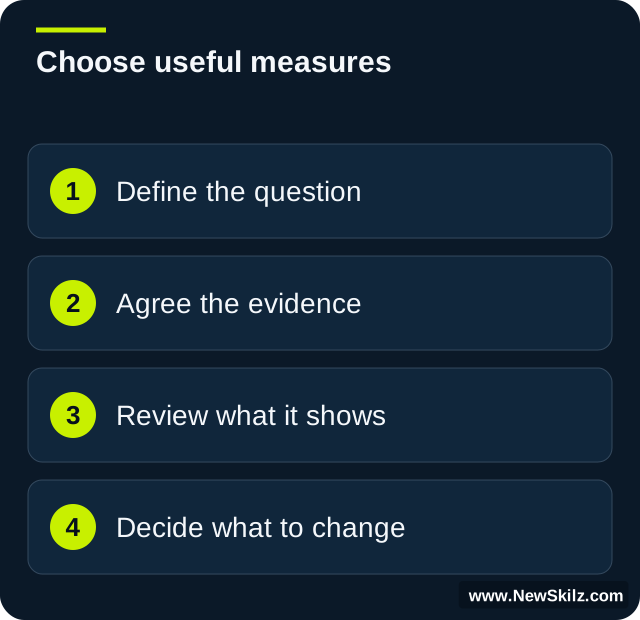
A useful measurement plan starts with decisions. Ask what the sponsor, programme owner and managers need to know, then agree evidence proportionate to the programme. Tailoring matters here as much as in content: the measures for a manager conversation programme should differ from those for role-based process learning.
Separate the questions you want to answer

Use several views rather than expecting one number to describe the programme:
- Delivery: did the agreed learning activity reach the intended people?
- Readiness: were the conditions in place for them to participate usefully?
- Learning: what could participants demonstrate or explain in the session?
- Application: what are they doing with the learning at work?
- Programme response: are issues and follow-up actions being resolved by their owners?
These views can support different decisions. Missed attendance may need a scheduling response. A recurring task error may need content clarification, manager support or a process decision. Keep the evidence close to the question it can actually answer.
Define each measure before you collect it

For each proposed measure, write its purpose, source, owner, review point and likely action. Agree what counts and what does not. “Completion” might mean attending a session, finishing a task or completing a series; those definitions should not drift between cohorts.
Use a simple measure card: “We will review [evidence] with [owner] at [point] to decide [action]. The evidence cannot establish [important limit].” If you cannot finish that sentence, reconsider whether collecting the measure serves the programme.
Choose a small set people can maintain. Existing work records or manager observations may be sufficient for a focused programme. A large reporting exercise can consume time without improving the decisions it is intended to support.
Apply the plan to an illustrative programme

Imagine training regional team coordinators to prepare complete service requests. Attendance confirms who reached the sessions. An approved practical task checks understanding during delivery. A later manager review examines a small set of relevant work examples and records recurring barriers.
The programme owner reviews the patterns with the business and technical owners. Incomplete information may reveal misunderstanding, missing access, an unclear process or limited opportunity to apply the task. The review assigns the next action to the appropriate owner instead of concluding that every problem needs more training.
Review the evidence alongside other workplace changes to understand what is helping, what is getting in the way and where to act next.
Read comments as evidence with a purpose
Participant feedback can identify relevance, clarity and practical problems. Ask questions that produce useful information: which task feels clearer, where does uncertainty remain, and what support will be needed at work?
Combine comments with other evidence where that is proportionate. A positive experience does not establish application; an awkward practical exercise does not automatically mean the learning failed. Look for patterns and seek context before changing the programme.
Avoid presenting illustrative targets as achieved results. Where you use a baseline or target, agree its source and meaning with the owner and report limitations plainly.
Make the review lead somewhere

Close the review with decisions, owners and next actions. Identify which evidence should be checked again and which no longer serves a useful purpose. Record unresolved questions honestly rather than filling the report with reassuring activity.
NewSkilz coordinates the agreed evidence and review rhythm, giving client owners a clear basis for priorities and specialist action. A successful reporting process makes those responsibilities visible and helps the programme respond to what people need. The point is to support better action after the dashboard has been read.
Make it relevant to your team.
Use your goals, roles and real situations to choose the next useful step.