
A neat calendar can conceal a programme that is impossible to attend. Three cohorts sit in sensible-looking slots, but the same team must provide operational cover for all of them. One region needs a different start time. The specialist who supports the practical activity is available for only two sessions.

Scheduling a multi-cohort programme means balancing delivery capacity with the circumstances of the people learning. Start with the audience and the work, then build the calendar. Dates chosen in isolation tend to move the problem somewhere else.
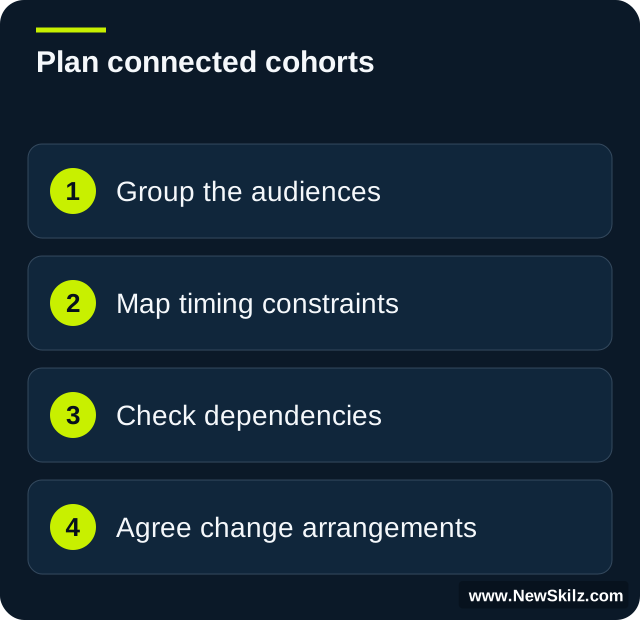
Build the cohort logic first

Decide what makes a useful group. Role, existing experience, tasks, language, location and availability can all matter. A mixed cohort may support useful discussion; it may also make a role-specific practical activity harder to run. Choose deliberately and explain the trade-off to the programme owner.
Ask managers how attendance affects operational cover and what periods should be avoided. Check the actual duration, preparation and follow-up expected of participants. A three-hour workshop with an hour of pre-work and a manager review is a larger commitment than its calendar invitation suggests.
Map the constraints that can move the dates

Use one planning view for constraints that affect the sequence:
- Participant availability and minimum operational cover.
- Facilitator availability and preparation time.
- Approved material release and any task dependencies.
- Venue, equipment or access requirements.
- Sequence between sessions and room for workplace application.
- Decision dates for nominations and changes.
Separate firm constraints from preferences. A room being pleasant is different from access being required for the core task. Confirm which owners can approve an exception rather than leaving every preference looking non-negotiable.
For international groups, publish the relevant local times clearly and verify the conversions for the actual dates. Check expectations around breaks and working hours with the local owners.
Try the schedule against an illustrative programme
Imagine a programme preparing three customer operations teams for a revised process. Each team needs two connected workshops with a practical task between them. One facilitator is available throughout; a process specialist must join the first workshop for questions.
A simple plan puts all first workshops in one week and all follow-ups in the next. Manager feedback shows that two teams cannot complete the workplace task in that gap because their work follows a longer cycle. The revised schedule groups those cohorts differently and preserves the application period.
The learning objective stays consistent. The dates reflect how the teams work. Record the reason so a later calendar change does not accidentally remove the very interval that makes the sequence useful.
Set change rules before invitations multiply

Decide how participants move between cohorts, who approves substitutions and when a change must be reviewed. Consider whether a substitution alters role mix, preparation or capacity. Avoid promising unlimited flexibility if a session depends on specific people or resources.
A useful scheduling record contains cohort purpose, participants or nomination status, local date and time, facilitator, prerequisites, confirmed dependencies and a change owner. Keep invitations consistent with that record and identify which is authoritative when information differs.
For a significant change, check every dependent communication. Moving a session can affect manager cover, pre-work deadlines, access support and the follow-up review. Updating the invitation alone leaves those dependencies stranded.
Leave a route for people who miss the sequence

Agree how absence will be handled before it happens. A later equivalent cohort, a supported catch-up or a differently scoped session may be suitable. Each choice needs an owner and an honest account of what participants still need to complete.
Review the schedule with three questions: can the right people attend, can the agreed learning activity run, and can participants apply it before the next stage? When the answer changes, bring the consequence back to the programme owner. A useful calendar expresses a workable programme; it cannot create one by itself.
Make it relevant to your team.
Use your goals, roles and real situations to choose the next useful step.