
A confirmed trainer can make a programme feel reassuringly real. The invitations go out, the sponsor sees a date, and the status report turns green. Then someone asks which roles need access to the practice environment. Nobody has checked. Delivery now depends on work that was invisible when the booking was made.

Readiness is the ability to run the intended learning experience with the intended people. It varies by programme. A manager workshop needs different preparation from role-based system training. Build the check around the tasks participants should handle afterwards, rather than borrowing a generic course checklist.
Start with the work the learning must support

Write a short statement of purpose with the programme owner: which people need to do what, in which working situation? “Learn the new process” leaves too much open. “Help team coordinators submit a complete request and explain its status to their manager” gives preparation a useful direction.
Ask the relevant business owner to approve the process and the technical owner to confirm any required access. The programme coordinator brings these dependencies together, with each specialist owner confirming readiness in their area. If an important task is still changing, record the uncertainty and who can resolve it.
Check six conditions before you call it ready

- Audience: the right roles are identified, with relevant experience and support needs understood.
- Content: the approved version covers the agreed tasks and examples.
- Access: participants and facilitators can reach the required materials, venue or environment.
- Delivery: the facilitator, timings and format fit the cohort.
- Preparation: joining instructions and manageable prerequisites have a clear owner.
- Follow-through: managers know what support or observation is expected afterwards.
For each condition, record evidence, an owner and a decision date. “IT is handling access” is a conversation starter. “Named technical owner confirmed the test accounts work for this cohort” is a readiness entry. Use the level of evidence appropriate to the actual risk.
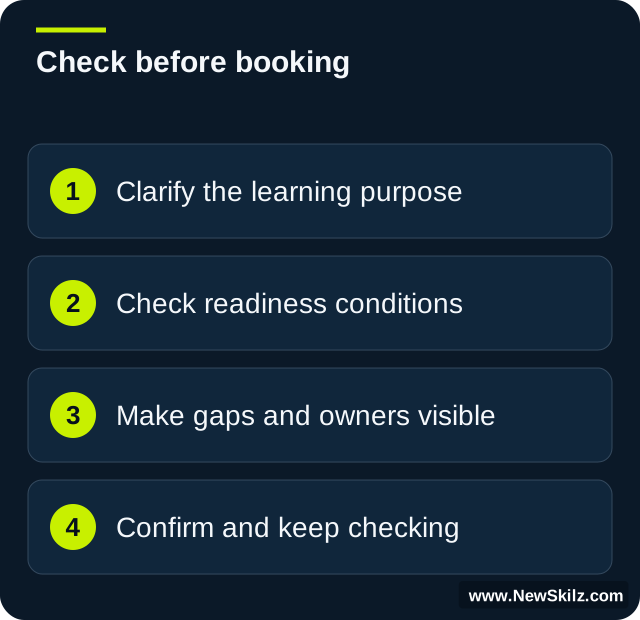
Make the unresolved items visible early

Consider an illustrative programme for customer support coordinators moving to a revised request process. The workshop materials are approved and the room is booked. A readiness review finds that temporary staff lack access and two supervisors have not agreed how requests will be reviewed after training.
The programme owner can now choose whether to resolve those gaps, alter the audience or adjust the date. Those are better choices than discovering the problems during delivery. Record the effect of each option on learning objectives and operational cover, rather than treating postponement as the only possible answer.
Some gaps are tolerable. Others prevent the core activity. Agree that distinction with the owner before pressure to keep the date takes over.
Use a small readiness record people will maintain
A working record needs enough detail to support a decision, without becoming another programme nobody has time to run. Start with these fields:
- Condition or dependency.
- Evidence available and what remains uncertain.
- Named owner and next action.
- Required date and impact if it slips.
- Decision: ready, ready with an agreed condition, or needs a decision.
Review it at milestones suited to the preparation effort. A short internal workshop may need one review. A programme involving several locations and access arrangements may need earlier checkpoints. Avoid assigning the same schedule to every programme simply because it worked last time.
Book with confidence, then keep checking
Booking can happen while some preparation continues. The useful discipline is to state which conditions are still open and when they must close. Confirm readiness again when a significant audience, content or delivery change occurs.
Before your next programme review, ask: what must be true for participants to complete the key activity? Who can confirm it? What would we change if it is not true? Those questions turn a date in the diary into a delivery plan people can act on.
Make it relevant to your team.
Use your goals, roles and real situations to choose the next useful step.