
A customer may meet several people from your SaaS team and still expect one coherent conversation. New starters need to practise their own contribution and how it connects to colleagues. A shared customer story makes those connections visible without pretending an Account Executive, Sales Engineer and Customer Success colleague need identical training.

Define the roles your organisation actually uses

Begin with your operating model. Confirm responsibilities, decision authority and handoff points rather than borrowing another company's job descriptions. Ask what each role should discover, explain, record and escalate at the relevant stage.
Choose one customer situation grounded in approved context. It might involve a buyer exploring a workflow, preparing a demonstration and later planning use of the agreed solution. Keep all product and implementation details within approved source material. Make unresolved questions part of the scenario instead of supplying convenient answers.
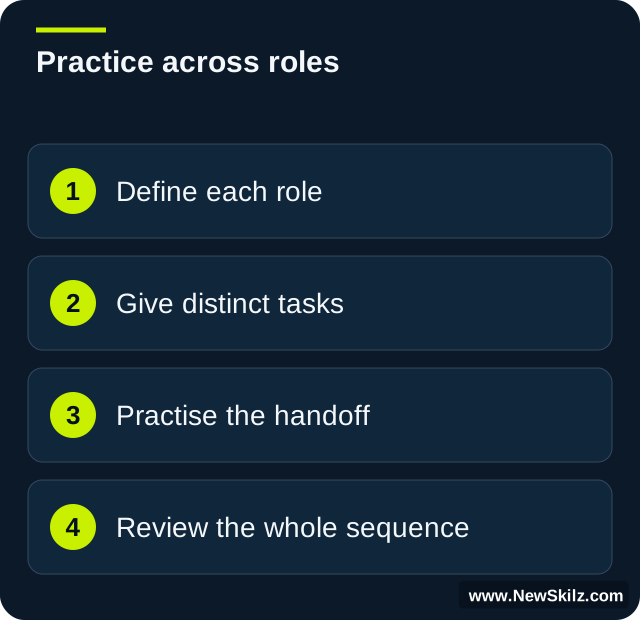
Give each role a distinct practice task

The Account Executive can practise clarifying business priorities and agreeing why a further conversation is needed. The Sales Engineer can practise checking technical requirements and presenting relevant approved capability. Customer Success can practise exploring the customer's intended use and clarifying responsibilities for a follow-up. Adapt these tasks to the client's actual role boundaries.
- AE prompt: What must the next colleague understand about the buyer's priority?
- SE prompt: Which requirement is confirmed, and which still needs investigation?
- CS prompt: What does the customer want to achieve, and what support or ownership needs clarification?
Different criteria keep the exercises relevant. A technical explanation should not be judged solely by sales-call fluency, and a commercial discovery task should not become an unplanned technical examination.
Make the handoff an activity, rather than a document
Ask the receiving colleague to work from the handoff and identify what they can use. Can they explain the customer context without asking the customer to restart? Do they know what was agreed and what remains uncertain? This tests the usefulness of the information, rather than the elegance of the template.
Illustrative example: an AE records that a buyer needs “better reporting”. During the practice handoff, the SE cannot choose a relevant demo route. The pair review the discovery notes and add the reporting task, current difficulty, important users and unresolved technical questions. The second handoff helps the SE prepare a focused meeting without treating the missing information as a product problem.
Run the sequence and review the joins

- Brief the shared customer situation and approved facts.
- Practise the first role's conversation.
- Prepare a short handoff using the team's process.
- Ask the next role to prepare from that handoff.
- Review gaps, assumptions and repeated questions.
- Replay the handoff with one useful improvement.
Keep feedback on both the individual contribution and the transition. A strong meeting can still produce a weak handoff. Equally, a complete form can contain assumptions that no one checked with the buyer.
Keep a small shared context record
“Customer priority: [confirmed need]. Context: [relevant facts]. Approved commitments: [what was agreed]. Open questions: [items and owners]. Next conversation: [purpose, people and timing].”
Use the team's existing systems and playbook for the record. The exercise should help colleagues use those processes, rather than create a parallel CRM. Confirm which customer information may be used in training and keep illustrative practice distinct from live customer records.
NewSkilz tailors role-specific scenarios around the client's approved product information and working arrangements. Practising the handoffs gives new starters a clearer view of the customer journey and how to work together using your team’s roles, knowledge and processes.
Make it relevant to your team.

Use your goals, roles and real situations to choose the next useful step.