
You have an established workshop, a recognised brand and a customer expecting a consistent experience. Sending the slide deck to a delivery partner leaves them to infer important details: why an activity matters, what can be adapted and how your organisation wants to be represented.

A useful delivery brief connects the approved programme to this audience and this engagement. Training providers and corporate learning teams can prepare NewSkilz to facilitate their established content, including under their brand. Agree the preparation and delivery scope explicitly; additional content authoring is a separate decision when it is needed.
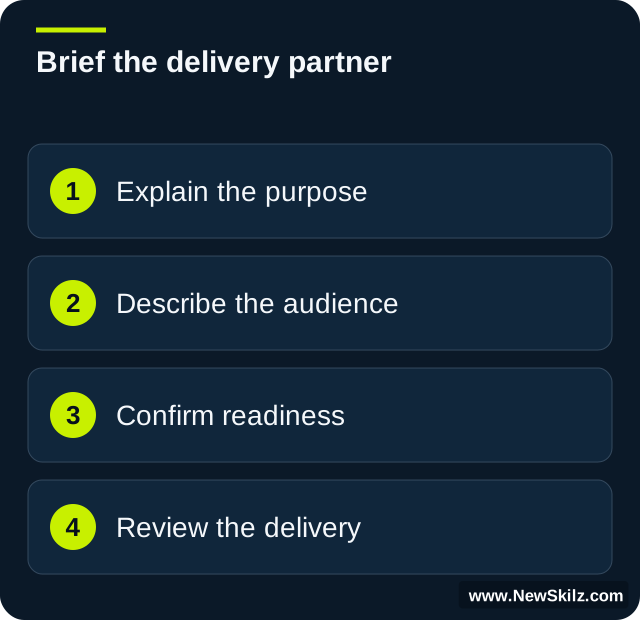
Explain the programme behind the slides

Give the partner the approved objectives, facilitator guide and participant materials. Identify the core activities, expected outputs and intended debrief points. Share why the programme is structured as it is, including any sequence that depends on earlier tasks.
Clarify which content is authoritative and who can answer factual questions. A delivery partner should know when to facilitate discussion, when to explain approved material and when to refer an unresolved question to the client's owner. They should not be asked to improvise a policy, product claim or technical decision.
Brief the audience and the brand expectations

Describe participants' roles, relevant experience, working situations and preparation needs. Agree the examples and terminology that will make the existing workshop useful to them. Tailoring here means informed facilitation and approved adaptation, while preserving the client's programme.
Where delivery is under your brand, confirm the practical expectations: how the facilitator introduces the engagement, which approved materials participants receive, how questions and feedback are handled, and who communicates with the customer. Make these details clear before the session rather than treating brand representation as an assumption.
Share only the audience information needed for preparation. Useful context should help the facilitator support participants without turning individual people into advance judgements.
Test the brief with an illustrative complication
Imagine a training provider asking a partner to deliver its manager decision workshop to a new customer cohort. The approved guide uses terminology unfamiliar to that customer. The content owner approves alternative role titles and retains the same decision task.
During preparation, the partner also learns that participants may ask about a pending customer policy change. The agreed response is to record those questions for the policy owner. The provider confirms who will follow them up and how the customer will receive the answer.
The facilitator now has room to make discussion relevant and a clear boundary around facts they do not own. That is a practical delivery brief, rather than an instruction simply to stay on script.
Confirm readiness around the consequential parts
Choose a preparation review proportionate to the workshop and the partner's familiarity with it. Focus any run-through on unfamiliar activities, difficult transitions or important debriefs. Check practical dependencies alongside content.
- Can the facilitator explain the intended audience and outcomes?
- Do they have the current approved delivery set?
- Can they explain and debrief the core activities?
- Are adaptation boundaries and brand expectations agreed?
- Are materials, venue or access requirements confirmed?
- Is there an owner for unresolved questions and delivery issues?
Record open actions with named owners and decision dates. Readiness should reveal support needs early. A later change to the audience, content or format should prompt a review of the affected preparation.
Keep the provider connected after delivery

Agree a concise delivery review: what ran as intended, where participants needed clarification, what was adapted and what needs attention. Distinguish a factual correction from a suggested improvement, then route each to its owner.
Use those findings to update the approved brief for future cohorts. Consistency comes from shared objectives, clear preparation and visible decisions. It gives a provider or corporate team a practical way to extend delivery while retaining control of the programme and its standards.
Make it relevant to your team.

Use your goals, roles and real situations to choose the next useful step.