
A calendar invitation tells someone when to turn up. It rarely tells them why the session matters, what they need to bring or what should happen if a prerequisite is missing. The resulting confusion is often treated as participant disorganisation. Sometimes the programme simply did not provide a clear route into the learning.

Joining instructions should remove avoidable uncertainty. Tailor them to the audience, format and activity. A leadership discussion may ask for a work example; a role-based process session may require access and a short preparation task. Neither benefits from a long generic message people have to decode.
Put the participant's questions in a useful order

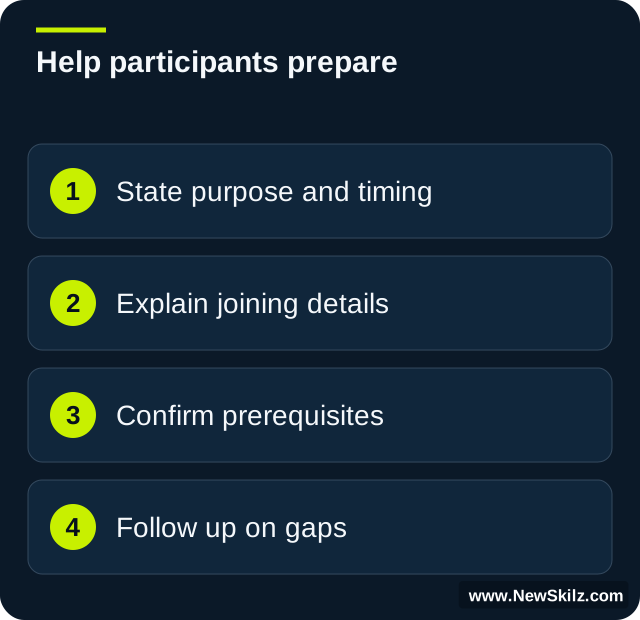
Start with what the session helps them do at work, followed by the essential logistics. State the date, time, duration, location or joining route and the preparation required. For a series, explain where this session sits and what earlier work it depends on.
Use clear headings and short instructions. Separate required preparation from optional background reading. If a task is required, explain its purpose, likely effort and where it should be completed or brought. Check the wording with someone who has not helped design the programme; unfamiliar readers often spot the ambiguity the project team misses.
Include a contact for practical problems, accessibility needs and questions about attendance. Make the action clear without asking participants to disclose unnecessary personal information in a group response.
Check prerequisites before they become an opening activity

Identify the conditions participants need for the main learning task. Access, equipment, approved materials, earlier sessions and manager support can all matter. Agree who confirms each condition and how participants report a problem.
In an illustrative programme for regional service coordinators, learners need to examine an approved request example in a training environment. The joining message asks them to confirm they can open the environment before the preparation deadline. Access problems go to the technical owner through the agreed support route; the coordinator tracks outstanding readiness.
This gives the technical owner time to resolve access issues before participants arrive. State the alternative plan if access remains unresolved, rather than leaving the facilitator to improvise on the day.
Use a message template that earns its length

Adapt this structure to your programme. Keep the details accurate and remove sections that serve no practical purpose:
- Purpose: after this session, you will be better prepared to handle [specific working task or conversation].
- When and where: [date, relevant local time, duration and confirmed joining route].
- Before attending: complete [required task] by [date], allowing approximately [agreed effort]. Bring [output] to the session.
- Access or materials: check [required condition] and report problems through [agreed route].
- Support: contact [named role or address] about practical needs or attendance changes.
- Afterwards: expect [agreed application task or manager follow-up].
Involve the relevant owners before issuing the message. A facilitator should confirm the preparation task; a programme owner should agree the audience and purpose; technical or venue owners should verify practical instructions. A well-written email still fails if its details are wrong.
If you include attachments or links, confirm participants can access them using their normal working arrangements. Use the approved material version and identify any replacement clearly.
Follow up where it helps readiness
Choose reminders according to the preparation required. A useful reminder highlights the next action and where to get help. Repeating the original long email can hide the important detail again.
Ask managers to support attendance and preparation when their role makes that appropriate. Tell them what the participant needs and why; avoid copying them into every operational message by default. Confirm who handles absences or substitutions so a change does not disappear into separate inboxes.
After delivery, review repeated joining questions and preparation difficulties. Adjust the instructions or the dependency itself. The aim is to make participants ready for the useful part of the session, with enough confidence to focus on learning when they arrive.
Make it relevant to your team.

Use your goals, roles and real situations to choose the next useful step.