

Choose an approach before choosing a question

A manager can become the team’s answer machine almost without noticing. Someone asks what to do, the manager supplies a solution, and work moves on. Repeated often enough, this pattern can leave both sides expecting the same exchange next time. Coaching offers another route: help a colleague examine the situation, make a recommendation and own a next step.
That does not make questions the right response to every request. A new colleague may need an explanation. An urgent decision may require clear direction. An organisational rule may leave no choice about the action. Decide what the situation needs before asking a clever-sounding question.
Check capability, boundaries and time

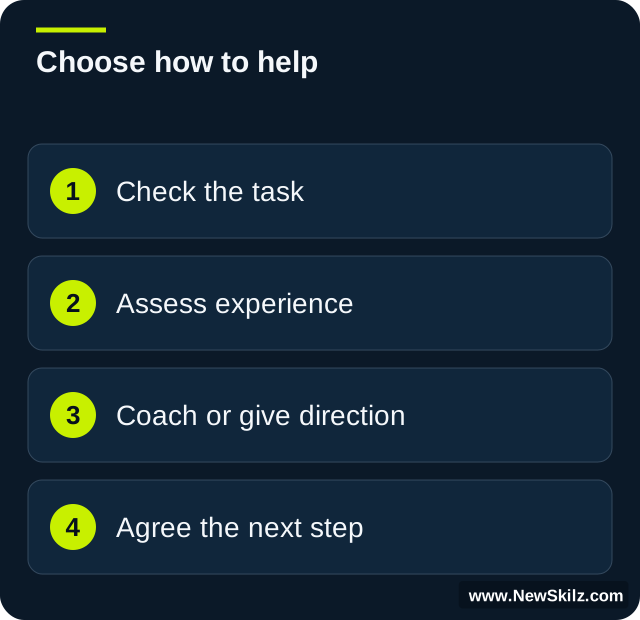
Use three checks. First, does the colleague have enough knowledge to work through the problem? Second, which decisions are theirs to make? Third, is there enough time to explore options? These checks keep coaching useful rather than evasive.
- Knowledge gap: explain the missing information, show an example or arrange support.
- Thinking gap: ask questions that help the colleague analyse and choose.
- Authority gap: clarify the decision boundary and the approval needed.
- Immediate action: give a clear instruction, explain its purpose and revisit the learning afterwards.
A colleague who cannot access the relevant information will not be helped by repeated “What do you think?” questions. Equally, a capable colleague may not need a complete answer just because they asked for one. Match the approach to the person and the work.
Explore before offering your preferred solution

Consider an illustrative situation: an experienced coordinator asks whether to move a workshop because several participants cannot attend. The manager could immediately name a new date. A coaching approach begins with the decision: “What does this session need to achieve, and which people are essential for that?” The coordinator can then compare attendance, trainer availability and programme dependencies.
Follow the colleague’s thinking. Useful prompts include “What options have you considered?”, “What would each option affect?” and “Which do you recommend, and why?” Ask one question at a time. Give the person time to answer. A rapid sequence of questions can feel like an examination and make it harder to think.
If information is missing, supply it openly: “The sponsor needs the output before Friday, so any new date has to preserve that.” Do not hide a non-negotiable constraint and wait for the colleague to guess it. Coaching works better when the person knows the actual decision space.
Make your advice visible when you give it
You can combine coaching with direction. After hearing the recommendation, explain where your own judgement adds value: “Your Tuesday option protects attendance. I would also check the materials deadline with the facilitator before confirming it.” The colleague still owns the investigation and recommendation.
Be careful with questions that disguise an instruction. “Don’t you think Tuesday would be better?” rarely opens genuine exploration. If you have decided, say so and give the reason. If you are inviting a recommendation, be willing to consider an answer different from your own.
Before ending, ask the colleague to summarise the action, who must be involved and when they will return with an update. Clarify what would trigger escalation. This supports independence within an agreed boundary; it does not remove the manager’s accountability.
Practise the choice as well as the conversation
Review one recent exchange using this mini-template: The task was… The colleague already knew… The decision boundary was… I chose to… The next action belonged to… Notice whether you provided information, supported thinking or quietly took the whole task back.
In a one-to-one, you can also ask what support the colleague finds useful: an example, time to explore, a review of their recommendation or a direct instruction. Their preference is information, not the only factor; the work and responsibilities still shape your choice.
Tailored leadership practice should reflect the organisation’s real decision rights and the managers’ experience. NewSkilz gives managers realistic role plays to practise switching between coaching, explaining and directing. They receive focused feedback on choosing the right approach and agreeing an action their colleague understands and can own.
Make it relevant to your team.

Use your goals, roles and real situations to choose the next useful step.