

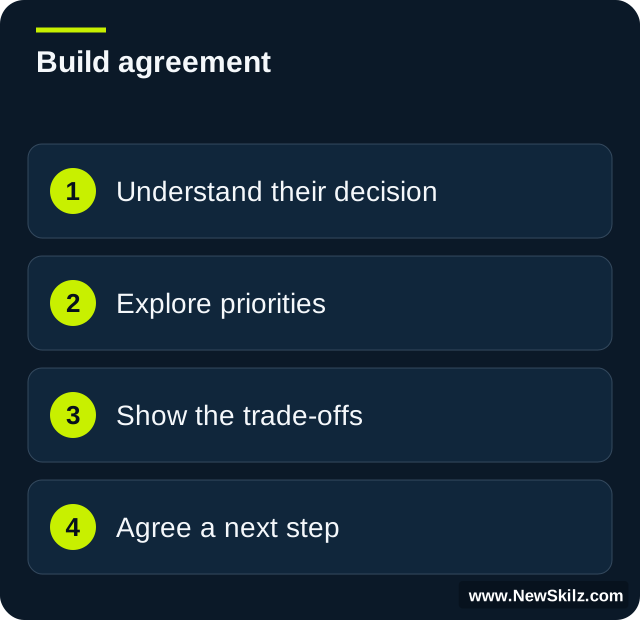
Start with the other team’s decision

“We need your help” describes your need, but it may tell another team very little about the decision you want them to make. Influence across teams begins with a clear request and a serious attempt to understand what that request would mean for them. They have responsibilities, constraints and commitments of their own.
Name the action you want: allocate a specialist, review a draft, change a handover or agree a delivery date. Then identify who can decide and who will do the work. A friendly conversation with the wrong person can leave everyone supportive and nothing authorised.
Understand priorities before polishing the pitch

Find out what the other team is accountable for, which deadlines matter and what would have to move if they accepted your request. Ask specific questions. “What is already committed in that week?” is easier to answer than “Why is this so difficult?” Be curious without treating their constraints as bargaining obstacles to overcome.
Explain your own dependencies too. A deadline may be flexible, linked to another activity or set by someone else. Distinguish those conditions. If you present every date as immovable, you remove options before the discussion begins and may weaken the credibility of the constraints that really are fixed.
- What outcome does each team need to protect?
- What work or resource is being requested?
- What would accepting the request displace?
- Which dates or standards are genuinely fixed?
- Who needs to approve any trade-off?
Offer a proposal with visible trade-offs

Consider an illustrative example: a learning manager needs an Operations specialist to help build realistic scenarios, but Operations is preparing for a busy delivery period. “Training is important” is unlikely to settle the conflict. A more useful proposal might be two focused reviews of an existing draft, supported by questions sent in advance, instead of asking the specialist to write the material.
State what you are offering as well as requesting: “We will prepare the examples and highlight the five points that need your judgement. Would you be able to review them on Wednesday, or is there another person with the relevant knowledge?” The proposal makes the work easier to assess while leaving space for a better option.
Compare alternatives honestly. Reducing the specialist’s input may affect credibility or require a later check. Moving the date may affect participant readiness. Do not bury those consequences in order to secure a yes. A useful agreement is one both teams can carry out with an accurate understanding of the impact.
Illustrative example from technical work: A project sponsor calls the new SaaS workflow a time-saver. The IT manager sees extra access requests, support calls and data checks during rollout. Ask which work increases, for whom and for how long before repeating the productivity benefit. Propose a defined pilot with a named support owner, prepared user guidance and a review of actual workload. The relevant owners agree the scope and responsibilities; the sponsor decides any trade-off.
Handle resistance as information

A refusal may mean the timing is impossible, the benefit is unclear, the wrong person has been asked or the work cannot meet the required standard. Ask which issue is blocking agreement. You do not need to win every point; you need to understand whether a workable route exists.
When priorities genuinely conflict, make the escalation transparent: “We have two commitments competing for the same capacity. Shall we take these options to the sponsor who can prioritise them?” Present both teams’ needs fairly. Escalation should help the right person decide, rather than punish a colleague for disagreeing.
Avoid promising an outcome outside your authority. Confirm what you can commit, what you need to check and when you will return with an answer. Reliability in these small commitments gives the relationship something practical to rest on.
Turn goodwill into an agreement

Record the action, scope, owner and timing. Include the information one team must supply before the other can begin. For the scenario review, agree the draft delivery date, the review questions and how comments will be consolidated. “Happy to support” is a useful start, but it is not yet a plan.
Use a preparation sentence: We need this action because it supports this outcome. We understand your constraint. These are the options we can offer. This is the decision we need from you. Adapt the wording to your relationship; do not recite it mechanically.
NewSkilz tailors influence practice to your team’s stakeholders, authority boundaries and real dependencies. Bring a proposal that keeps stalling, with appropriate organisational context. Participants practise explaining value, understanding competing priorities and agreeing a specific next step with the people involved.
Make it relevant to your team.
Use your goals, roles and real situations to choose the next useful step.