
A new starter's first month can fill up with information while conversation practice waits for a quiet day. Put practice into the plan deliberately. The sequence below is illustrative: adapt it to the role, prior experience, internal training and responsibilities your manager authorises. A calendar date alone does not make someone ready for a customer meeting.

Begin with the role and its inputs

Before day one, identify the tasks the starter should prepare for and the approved sources they will use. Confirm the manager, content owners and practice support. Check which product learning or systems access must precede each exercise.
Choose a handful of realistic scenarios that become progressively more demanding. Keep them small enough to replay. Include an unknown question and a handoff so the programme develops responsible use of knowledge, rather than rewarding only polished explanations.
Week one: understand and explain

Use the first stage to connect essential internal learning to a short conversation. After the relevant product and buyer briefing, ask the starter to explain an approved capability in a buyer's context. Practise opening a meeting with a purpose and checking what the buyer wants to address.
Feedback can focus on relevance, clarity and factual boundaries. If the learner cannot identify the appropriate source, pause the exercise and resolve that preparation need. Do not use a simulation as an excuse to let the facilitator improvise product knowledge.
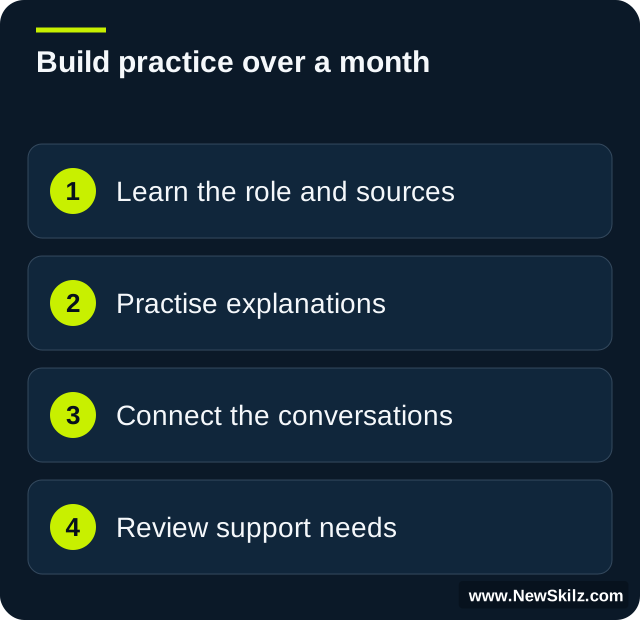
Weeks two and three: follow the conversation
Introduce a discovery scenario in which the buyer's first answer is incomplete. Practise a useful follow-up and summary. Then add a concern, a plausible interruption or a request outside the learner's authority. Keep the criteria aligned with the role and your approved playbook.
Illustrative example: a new AE first rehearses an opening call about a reporting problem. In the next exercise, the buyer explains that the real issue is delayed internal approval. Later, the buyer asks an unresolved integration question. The learner must adjust their discovery, avoid an unconfirmed answer and brief a technical colleague. The sequence uses one customer story to build different behaviours without asking the starter to master everything at once.
Week four: connect the parts and review support
Run a fuller role-specific attempt that combines the opening, relevant questioning, approved explanation and next step. Include a handoff where appropriate. Ask the manager to review specific evidence and decide what support the starter needs for the next responsibility.
- Which behaviours are becoming consistent?
- What factual knowledge still needs internal learning?
- Which task can the starter attempt with support?
- Where is another rehearsal needed?
- What will the manager review next?
Use the answers to agree the next stage: which customer conversations the new starter is ready to handle, what support they need and who will review progress.
Run a repeatable weekly loop
- Complete the internal learning needed for the selected task.
- Brief the role, buyer situation and approved facts.
- Run an attempt against a small feedback focus.
- Agree one practical adjustment.
- Replay and record the evidence.
- Choose the next practice or knowledge action with the manager.
“This stage's task: [conversation]. Preparation: [approved learning]. Practice: [scenario]. Feedback: [behaviours]. Readiness decision: [owner]. Next support: [action].”
Schedule the owner and preparation as carefully as the session itself. If internal learning moves, update the practice dependency rather than carrying on with an exercise the learner cannot yet complete.
NewSkilz shapes the practice layer around your onboarding programme, buyers and roles. Your product training and playbook provide the foundation. The first-month practice plan gives new starters structured opportunities to apply that knowledge and managers a clear basis for coaching and support.
Make it relevant to your team.
Use your goals, roles and real situations to choose the next useful step.