

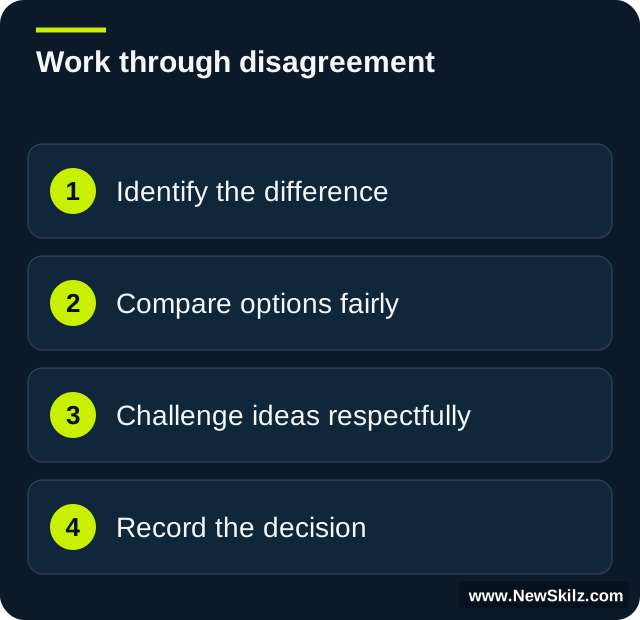
Find out what people are disagreeing about

A disagreement can look like a clash of personalities when people are actually arguing about different things. One colleague is worried about timing; another is protecting quality; a third thinks the decision has already been made. Before trying to settle the debate, identify the question each person is answering.
Ask participants to state their concern in a sentence and describe the practical consequence. Then summarise the points without attaching motives. “You want an earlier date because the team needs preparation time; you want a later date because the materials need review” gives the discussion a workable shape.
Check whether the disagreement concerns facts, options, priorities or authority. Missing facts need investigation. Different options need comparison. Competing priorities may require an authorised decision. An unclear decision process needs clarification. Treating all four as a persuasion contest can keep the argument going unnecessarily.
Create a fair comparison
Consider an illustrative example: two managers disagree about whether to run a workshop for all supervisors together or split it into smaller cohorts. One wants a shared conversation; the other cannot release every supervisor at once. Both aims may be legitimate, but they imply different constraints.
Ask the group to agree the criteria before defending a preferred option. For this decision, criteria might include operational cover, participation, opportunities to practise and facilitator availability. Put the options alongside those criteria and identify the information still needed. This turns preferences into proposals that others can examine.
- What would this option enable?
- What would it make harder?
- Which assumption are we relying on?
- What information could change our view?
- Which constraint must the final choice respect?
Avoid false balance. If one option conflicts with an approved requirement, state that clearly. If evidence is incomplete, describe the uncertainty. A fair comparison does not mean pretending all proposals are equally workable.
Keep challenge focused on the work

Invite people to challenge the proposal rather than the person. “The second cohort would miss the project launch” provides useful information. “You always make this complicated” changes the subject and gives the other person a personal accusation to answer.
As the manager or facilitator, intervene early enough to keep the discussion useful. Try: “I want us to stay with the scheduling concern. What consequence would the second cohort face?” Explain the purpose of the intervention. You can maintain a boundary on the discussion while still inviting a strong objection.
Notice who has not contributed. A quieter colleague may hold the information that resolves an assumption. Ask for their relevant perspective without demanding that they take sides. If the same points are repeating, summarise the remaining difference and name what would help resolve it.
Check your own position too. If you are responsible for the decision and have a preferred option, say so. People should know whether you are facilitating exploration, seeking advice or explaining a decision you have already made.
Close the decision without manufacturing agreement

Confirm who decides and how the choice will be made. A decision maker can listen seriously to a challenge and still choose another option. State the reason and acknowledge the concern that remains. “We will use two cohorts to preserve operational cover; we will also arrange a joint follow-up discussion” is clearer than announcing that everyone is now aligned.
Record the decision, owner, practical next step and conditions that would trigger review. In the cohort example, an attendance threshold or a materials delay might require the plan to be revisited. The review condition should relate to the work, rather than reopening the choice whenever someone remains disappointed.
Afterwards, ask whether the discussion surfaced useful information and whether people understand what happens next. Respectful disagreement does not require everyone to enjoy the outcome. It requires a process they can understand and an action they can carry out.
Leadership practice can use decisions your managers actually face, with the organisation’s approval boundaries and typical stakeholder tensions. NewSkilz turns those situations into role plays where managers practise inviting challenge, comparing alternatives and closing a disputed decision with clarity.
Make it relevant to your team.

Use your goals, roles and real situations to choose the next useful step.