

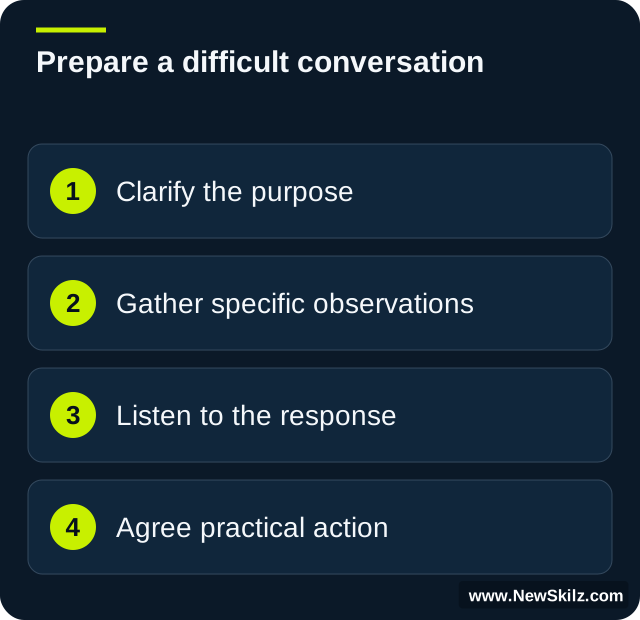
Give the conversation a clear purpose

A difficult conversation can become larger in your head each time you postpone it. You rehearse the colleague’s worst response, gather more frustration and wait for the perfect opening. Preparation helps when it brings the discussion back to a specific issue and a useful outcome.
Write down what needs addressing and what you want to agree. “Resolve the tension” is broad. “Understand why agreed handover information is missing and agree how we complete the next handover” gives both people something concrete to work on. Consider whether this is an ordinary management discussion or an issue that needs the organisation’s approved process and support.
Prepare a fair account of what happened

List the relevant observations, the expectations that were communicated and the practical effect. Separate those facts from assumptions about intention. A colleague may have missed a step; you cannot conclude from that alone that they wanted to undermine you.
Check your own part in the situation. Were the responsibilities clear? Did you respond to an earlier request for help? Have you changed the priority without explaining it? Acknowledging your contribution does not erase the colleague’s responsibilities. It makes the account more accurate and can help the discussion stay focused on the work.
- What exactly needs to be discussed?
- Which examples can I describe accurately?
- What expectation or agreement applies?
- What do I need to hear from the colleague?
- What support, boundary or next action may be needed?
Open the issue without delivering a verdict

An illustrative example: two team members keep passing an incomplete customer handover between them, while each says the other should finish it. The manager arranges a private conversation with one colleague and opens: “I want to understand the handover gap and agree who completes which parts. On the last two accounts, the implementation notes were missing when the handover was due. How are you interpreting the responsibility for those notes?”
This opening names the issue and gives the colleague a chance to explain. It does not begin with “You are being difficult.” Listen for a disagreement about ownership, missing information or a genuine capacity problem. You may need to clarify the process with both colleagues after hearing their accounts.
Choose a setting and timing that allow a reasonable discussion. Avoid raising a complex issue as someone is leaving for another meeting. Tell the colleague the topic clearly enough to prepare; a mysterious “We need to talk” message can add uncertainty without helping the work.
Stay with the purpose when the response is uncomfortable
Defensiveness, silence or a counter-example can unsettle a manager. You do not need a script for every possible response, but it helps to practise a few constructive moves. Summarise what you heard, check understanding and return to the issue that needs resolving.
Useful wording might be: “You are saying the information arrives after your deadline. Let us check that dependency.” Or: “I understand you disagree with my account. Which part do you see differently?” Acknowledge a relevant point without abandoning the expectation you need to explain.
If the discussion becomes unproductive, pause deliberately and agree how it will resume. Explain what needs to happen next rather than ending with a vague promise to revisit it. Where behaviour or the nature of the issue requires organisational support, follow that route. Prepare the conversation in line with that procedure and the support available.
Finish with an agreement that survives the meeting

Summarise the action, ownership and support agreed. Identify any fact or decision still outstanding and name who will obtain it. In the handover example, the manager might clarify that one colleague supplies implementation notes while the other checks completeness, with a defined point for flagging missing inputs.
Ask both what a useful next handover should look like and when the new arrangement will be reviewed. Record the agreement appropriately and use the review to examine actual work. The purpose is to address the issue, not to congratulate everyone for having a difficult conversation.
NewSkilz tailors role plays to the situations your managers have been avoiding, using suitable anonymised examples and your organisational expectations. Practise a direct opening, listening under pressure and a clear close. Focused feedback gives managers a chance to adjust the approach before the real discussion.
Make it relevant to your team.
Use your goals, roles and real situations to choose the next useful step.