

Decide which role you are taking

A manager may chair a meeting, contribute expertise and make the final decision in the same hour. Each role is legitimate, but switching between them silently can confuse the team. People need to know when you are inviting exploration and when you are setting a direction.
At the start, explain the purpose and decision boundary: “We will develop options together. I will choose the final approach against these criteria after hearing your recommendations.” That is a different discussion from one where the group has authority to agree the choice itself.
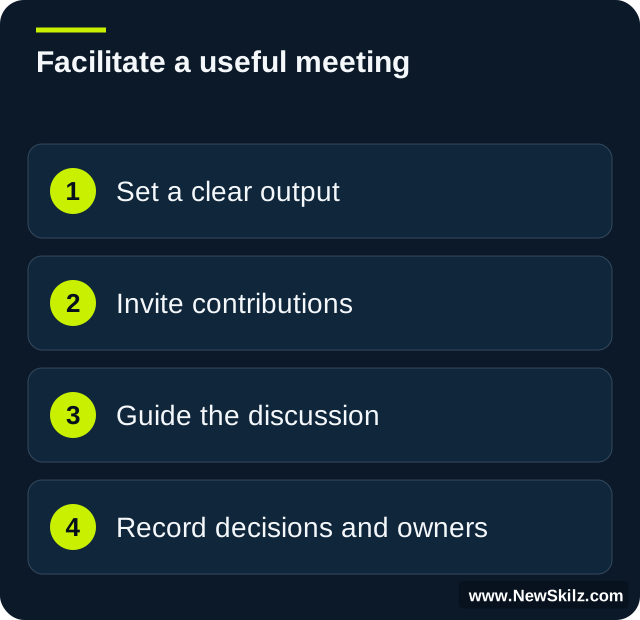
Set an output the group can recognise

“Have a useful discussion” gives a facilitator little to guide. Define the output: a shortlist of options, an agreed handover, a recommendation or a set of actions. Explain how the discussion will produce it and how much time is available.
Use prompts that serve the task. If the team needs to improve a process, begin with where the current work breaks down. If it needs to prioritise, establish criteria before collecting favourite projects. The activity should help people think about the actual question rather than simply keep them busy.
Invite contributions before evaluating them
In an illustrative session, a manager wants ideas for a more reliable customer handover. If they open with their own preferred process, colleagues may only comment on that design. Instead, ask everyone to identify one point where the current handover loses information, then compare the patterns.
Brief individual thinking can give people time to prepare before a group discussion. Ask for relevant examples and make the contribution task specific. You can then group similar points and check that your summary reflects what people meant.
Separate collecting ideas from judging them. Premature evaluation can narrow the conversation before useful information appears. Once the group has a set of options, bring it back to the criteria and constraints. Exploration still needs a destination.
Use small interventions with a clear purpose
Facilitation does not require a constant stream of commentary. Often the useful move is a short question, summary or boundary. If a participant dominates, thank them for the relevant point and invite another perspective. If the discussion drifts, restate the output and park the unrelated issue with an owner.
- Clarify: “What would that look like in the actual handover?”
- Connect: “How does that address the gap we identified?”
- Include: “Who sees a different dependency?”
- Summarise: “We have two options and one fact to check.”
- Close: “Which action follows from this decision?”
Be transparent when you move from facilitation to your managerial contribution. Say “I need to add a constraint from our delivery plan” rather than presenting your own preference as the group’s conclusion.
Turn the discussion into a usable record

Before closing, check what the group produced. In the handover example, that might be a revised information checklist, an owner for the trial and a review date. Read back the essentials and confirm that each owner understands the action.
If the output is a recommendation, name who will receive it and how participants will hear the decision. Do not imply that collecting ideas creates approval. If a point remains unresolved, state what needs checking and who will check it.
After the session, keep the record concise enough to use. A page of decisions and actions may be more useful than a long transcript. The record should connect to the output you promised at the start.
Practise with the meeting you actually run
Review one recurring meeting: what is its purpose, what do participants contribute and what comes out of it? Choose one facilitation move to practise at the next session. Observe whether it helped the group work on the task, rather than judging your performance by how much you spoke.
NewSkilz tailors facilitation practice to your managers’ meeting types, organisational expectations and decision responsibilities. Use a realistic team discussion, practise interventions and receive feedback on the effect. Managers practise guiding the group towards a clear decision, with the right people involved and an agreed next step.
Make it relevant to your team.

Use your goals, roles and real situations to choose the next useful step.