
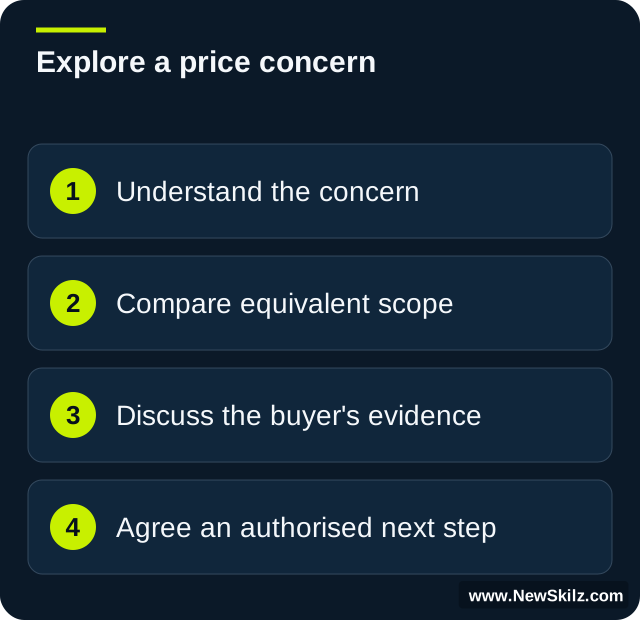
“Your competitor costs less.” It is a short sentence with several possible meanings. The buyer may be comparing different scopes, working within a fixed budget, testing your flexibility or questioning whether the offer matters enough. A useful response starts by understanding the comparison before treating a discount as the answer.

Slow the response enough to understand the concern

Acknowledge the issue plainly: “Price matters. Can we look at what you are comparing?” Then choose a follow-up appropriate to the answer. Ask whether the concern is the total commitment, a specific element, the timing or confidence in the value. Give the buyer room to explain without making them defend a purchasing decision.
Keep your tone curious and commercially clear. An immediate argument about quality can sound dismissive. An immediate concession can leave the underlying concern untouched. The purpose of the question is to establish which problem the commercial conversation needs to solve.
Compare the same thing before debating the number
Create a factual view of the proposed scope and what the buyer understands the alternative to include. Relevant items may include agreed users, services, support, implementation responsibilities or contract period. Use approved information and ask the buyer to confirm their assumptions. Avoid inventing deficiencies in a competitor’s offer.
- Which requirements are essential to the buying decision?
- Which inclusions are being compared?
- What responsibilities would remain with the buyer?
- What still needs confirmation before the comparison is useful?
Some differences may be irrelevant to the buyer. Do not recite every inclusion as though each one carries equal value. Connect the discussion to the priorities established in discovery.
Explore value through the buyer’s evidence
An illustrative finance lead questions a larger commitment because they are unsure whether regional teams will use the service. The seller’s first instinct is to reduce the price. A follow-up reveals that the buyer needs a credible participation and application plan before they can support any spend.
The next conversation should examine those conditions and the people who own them. A discount would not establish use. Ask what change the buyer expects, how they would recognise it and what assumptions underpin their case. Keep potential benefits separate from proven results. If the required value cannot be supported, say what needs further investigation.
Keep negotiation inside your authority

Prepare your commercial boundaries before the meeting: what you can explain, what options are approved and what requires another owner’s decision. Scope, timing and delivery choices may sometimes provide useful options, but only where your business authorises them. Do not make a concession or add an inclusion simply to avoid an awkward pause.
Record the buyer’s request accurately, including its reason. An internal note saying “wants a lower price” loses information. “Budget approval covers a smaller initial scope; finance wants the remaining requirements and responsibilities clarified” gives the commercial owner a better decision to make. Be explicit when an option is subject to approval.
Practise a conversation with a decision at the end

Use a short role play in which the buyer raises price and then reveals a concern only if the seller explores it. Observe whether the seller identifies the comparison, connects to a confirmed priority and stays within their authority. Give feedback on the question and explanation, rather than praising assertiveness in the abstract.
A useful close is: “We have clarified the scope comparison. Your remaining concern is confidence in participation. Shall we involve the programme owner to examine that before revisiting the commercial options?” Agree the appropriate owner and next step. The price conversation has made progress when the real decision becomes clearer.
NewSkilz builds price-conversation practice from your buying situations, approved evidence and commercial boundaries.
Make it relevant to your team.

Use your goals, roles and real situations to choose the next useful step.